The Creator coming in the flesh in itself is outrageous, incomprehensible. The purpose of His coming is all the more outrageous and incomprehensible. “He humbled himself and became obedient to death—even death on a cross!” (Philippians 2:6-8).
The Son of God, as man, experienced the power of temptation at a level of intensity no other man has experienced. How do we put our minds around God, in the flesh, feeling the pain of the soldier’s whip and the spikes impaling Him on the cross. Jesus died, the Son knowing the Father’s wrath for our sins inflicted upon Him. He knew humiliation. The Creator of all, surrendered His sovereignty for the shame of the cross, inflicted upon Him by His enemies. The Son of God, who was with God, equal with God, one with God, voluntarily relinquished His glory to the power of the Enemy. He “made himself nothing, taking the very nature of a servant” (Philippians 2:7). “For you know the grace of our Lord Jesus Christ, that though he was rich, yet for your sakes he became poor, so that you through his poverty might become rich” (2 Corinthians 8:9). For our sakes!
“Very rarely will anyone die for a righteous man, though for a good man someone might possibly dare to die. But God demonstrates his own love for us in this: While we were still sinners, Christ died for us.” By this outrageous and incomprehensible love God calls us to faith in God through Jesus Christ. He calls us forgiveness, to peace with God, to new life in Christ, to hope. (Romans 5:1-11).
“This is how God showed his love among us: He sent his one and only Son into the world that we might live through him…sent his Son as an atoning sacrifice for our sins” (1 John 4:9-10).
An outrageous claim on which Christian faith and hope stands. God with us. “The Power of all Creation stooping so low as to become one of us.”
At the core of Christian faith is an outrageous claim. God, in the person of his Son, came to dwell on the earth as a human being. The Creator of all things, the one whom “the heavens, even the highest heaven, cannot contain,” came in the flesh as a human being. He came as the man, Jesus of Nazareth. He was conceived in the womb of a young woman, a virgin. As any human child, He was born, grew, lived, and died!
The apostle John wrote, “In the beginning was the Word, and the Word was with God, and the Word was God. He was with God in the beginning. Through him all things were made; without him nothing was made that has been made. The Word became flesh and made his dwelling among us” (John 1:1-3, 14).
Similarly the apostle Paul wrote of Jesus, “Who, being in very nature God, did not consider equality with God something to be grasped, but made himself nothing, taking the very nature of a servant, being made in human likeness. And being found in appearance as a man, he humbled himself and became obedient to death–even death on a cross!” (Philippians 2:6-8).
In his book, God Came Near, Max Lucado vividly captures the mystery and the awe of the coming of the Son of God in the flesh. “The omnipotent, in one instant, made himself breakable. He who had been spirit became pierceable. He who was larger than the universe became an embryo. And he who sustains the world with a word chose to be dependent upon the nourishment of a young girl. God as a fetus. Holiness sleeping in a womb. The creator of life being created.”1
One writer expressed his struggle with the outrageousness of the claim of Christianity. “The virgin birth has never been a major stumbling block in my struggle with Christianity; it’s far less mind-boggling than the Power of all Creation stooping so low as to become one of us.”2
C. S. Lewis calls the incarnation, God coming in the flesh, Jesus, Immanuel, God with us, the grand miracle. “The Christian story is precisely the story of one grand miracle, the Christian assertion being that what is beyond all space and time, what is uncreated, eternal, came into nature, into human nature, descended into His own universe, and rose again, bringing nature up with Him.”3
Christians place their faith in this one grand miracle, in this outrageous claim. “The Power of all Creation stooping so low as to become one of us.” Immanuel—God with us.
1 Max Lucado, God Came Near (Portland, OR: Multnomah Press, 1987), 25.
2 ChristianityTodayLIbrary.com, 12/4/2000.
3 C. S. Lewis, “The Grand Miracle” in God in the Dock (Grand Rapids: Eerdmans, 1970, 1997), 80.
The nations around ancient Israel had physical representations, idols, of their gods. Often the ancient prophets of Yahweh rebuked Israel for wanting to imitate their neighbors. They made idols fashioned after cattle or humans to represent Yahweh, equating God with wood, stone, or a precious metal.
One of these rebukes is found in Isaiah 40. “Who has measured the waters in the hollow of his hand, or with the breadth of his hand marked off the heavens? Who has held the dust of the earth in a basket, or weighed the mountains on his scales and the hills in a balance? To whom, then, will you compare God? What image will you compare him to? He sits enthroned above the circle of the earth, and its people are like grasshoppers. He stretches out the heavens like a canopy and spreads them out like a tent to live in. ‘To whom will you compare me? Or who is my equal?’ says the Holy One. Lift your eyes and look to the heavens: Who created all these? He who brings out the starry host one by one, and calls them each by name. Because of his great power and mighty strength, not one of them is missing” (Isaiah 40:12, 18, 22, 25,26).
We read in Isaiah’s words “the inexpressible wonder of God’s person!” Yahweh is “like no one or nothing else.”1 God is beyond our imagination and our full comprehension.
King Solomon was under no illusions concerning Yahweh as he built the Temple. Yahweh, the God of Abraham, Isaac, and Jacob, is nothing like the false gods whose dead statues of wood and stone were housed in pagan temples. When the Temple in Jerusalem was completed it was dedicated by Solomon. “Then Solomon stood before the altar of the LORD in front of the whole assembly of Israel, spread out his hands toward heaven and said: ‘O LORD, God of Israel, there is no God like you in heaven above or on earth below–you who keep your covenant of love with your servants who continue wholeheartedly in your way. But will God really dwell on earth? The heavens, even the highest heaven, cannot contain you. How much less this temple I have built” (1 Kings 8:22-23, 27).
Disciples of Jesus Christ read Isaiah’s words and those of Solomon. In response, with faith in and emphatic praise of Yahweh, the God of the Bible, the Power of all Creation, disciples of Christ cry out, “Amen!”
Yet… Matthew in his Gospel wrote of Mary, a virgin, conceiving a child through the Holy Spirit. Of this he wrote, “All this took place to fulfill what the Lord had said through the prophet: ‘The virgin will be with child and will give birth to a son, and they will call him Immanuel’—which means, ‘God with us’” (Matthew 1:22-23).
1 Jim McGuiggan, Jesus, Hero of Thy Soul (West Monroe, LA: Howard Publishing, 1998), 192-3.
Yesterday I was at St. Jude Children’s Research Hospital helping to set up the Christmas Store. The toys are stored in the former surgical unit. This was where Sully had his procedures. As I walked in the two surgery rooms I pictured Sully. This may be difficult for you to understand, it is for me. I was not saddened by the pictures I imagined. What words best describe how I felt? A calm assurance, a heart comforted, as if I was there with Sully. So this morning as I thought of yesterday I remembered this post and wanted to reshape it. I focus on pediatric cancer but there are many other diseases which rob children of life all too early. These children and there families are also on my heart this morning. God’s blessings to all who read this.
In Revelation 12 the Apostle John describes a very different scene of the birth of Jesus. John uses bold, vivid, striking, and startling images. His is a story powerfully and imaginatively revealing the spiritual reality of God’s invasion into his creation through Jesus Christ. The physical images are larger than life. A pregnant woman about to give birth is clothed with the sun. The moon is the rest for her feet. A rather immense image. There appears an enormous seven headed red dragon whose tail swept a third of the stars out of the sky. The dragon stood in front of the woman waiting to devour the baby when he was born. When the woman gave birth to her son he was snatched up to God and to his throne, where he will rule all the nations with an iron scepter. The images are not the reality but powerfully represent…
San Bernardino, Paris, Umpqua Community College, terrorism, hatred, fear. Personal loss and pain, whatever it is you have experienced or are experiencing. Cancer, pediatric cancers, Alzheimers, other debilitating and life threatening diseases, debilitating and life threatening injuries. Henry Wadsworth Longfellow speaks for many with his words written on Christmas Day, 1861. “How inexpressibly sad are all holidays.” The sixth verse of his poem, “Christmas Bells”, also speaks for many.
And in despair I bowed my head;
“There is no peace on earth,” I said;
“For hate is strong,
And mocks the song
Of peace on earth, good-will to men!”
During the years of the American Civil War a darkness covered the heart of Longfellow. Grief, despair, and hopelessness found a home in his soul. Students of Longfellow’s died in the war. His son Charles sustained crippling injuries in battle. On July 10, 1861 his wife Fannie tragically died. She cut the hair of their seven year old daughter, Edith, on July 9. Fannie wanted to save the clippings of Edith’s hair in sealing wax. While melting a bar of wax some hot wax fell on her dress, catching the dress on fire. Fannie ran into the library to her husband. Longfellow desperately tried to extinguish the fire. He was finally able to extinguish the flames. It was too late. Fannie died the next day. Longfellow bore scars on his arms and face the rest of his life, constant reminders.
Overwhelmed with grief, Longfellow’s writings became darker. One year after Fannie’s death he wrote, “I can make no record of these days. Better leave them wrapped in silence. Perhaps someday God will give me peace.” On Christmas Day, 1862, his journal entry reads, “‘A merry Christmas’ say the children, but that is no more for me.” Longfellow’s son Charles was shot between the shoulder blades in battle in 1863 causing a crippling spine injury. Christmas Day 1863 Longfellow’s journal is silent.
On Christmas Day 1864 Longfellow opened a window. He heard the church bells ringing. Remembering the angels’ song to the shepherds in Luke 2:14, Longfellow wrote the poem “Christmas Bells.” (The complete poem is found at the end of this post.)
The poem begins with the beauty and wondrous hope of the angels’ song to the shepherds. As the poem continues, the sounds, sufferings, and horrors of war drown out the angels’ song. There is no peace. Nothing had changed. Longfellow’s wife was still dead. Charles, his son, was still crippled. The war was still raging. Longfellow expresses despair and hopelessness. “And in despair I bowed my head; ‘There is no peace on earth,’ I said; ‘for hate is strong, And mocks the song Of peace on earth, good-will to men!”
Centuries before Longfellow another poet wrote words of despair and hopelessness. “Awake, O Lord! Why do you sleep? Rouse yourself! Do not reject us forever. Why do you hide your face and forget our misery and oppression? We are brought down to the dust; our bodies cling to the ground” (Psalm 44:23-25).
Longfellow listened to the song of the church bells on that Christmas day in 1864. He wrote of despair and hopelessness. The song of the angels was not true. As he listened to the bells, in the midst of the darkness, a light began to shine in his heart. Despair and hopelessness gave way to faith and hope. The final verse proclaims:
Then pealed the bells more loud and deep:
“God is not dead; nor doth he sleep!
The Wrong shall fail,
The Right prevail,
With peace on earth, good-will to men!”
In the song of the psalmist the light of faith and hope in God began to shine in the midst of the darkness. “Rise up and help us; redeem us because of your unfailing love” (Psalm 44:26).
The angels’ song was not in vain. With the Child born in Bethlehem came the light of God’s grace and the hope of his salvation. God’s light came into the darkness. In the great battle on the cross and in the grave, Jesus Christ won the victory. The chains of death have been broken. The hope of life has been given.
The Enemy is still lurking. Skirmishes are still being fault, often fierce and deadly. Yet for the children of God in Christ there is light and peace in the midst of the darkness, in the midst of the raging sounds of war. Their hope in Christ is sure. The apostle Paul writes of God’s wisdom, power, and love at work through Christ. “And through him to reconcile to himself all things, whether things on earth or things in heaven, by making peace through his blood, shed on the cross” (Colossians 1:20).
So often in Scripture the strongest statements of peace and comfort, of hope and life, are made in the midst of suffering. For the sake of space I ask you to read in your Bible Lamentations 3:19-25. Also read the words of the apostle Paul in 2 Corinthians 12:7-10.
Notice the change in Paul’s attitude in the 2 Corinthians text. Paul knew peace and hope through the assurance of Christ’s presence even in the most difficult times. By His presence Christ was strengthening Paul, enabling him to persevere. Paul was not alone in the darkness. Rather within the darkness the light of Christ shone in Paul’s heart. “God is not dead; nor doth he sleep!”
For many Longfellow’s words of despair and hopelessness are so familiar to their hearts. Yet in the midst of the darkness the light of Christ shines. It is light seen only through faith, but it is bright. For this faith hears Jesus’ words of encouragement. “My grace is sufficient for you, for my power is made perfect in weakness” (2 Corinthians 12:9).
Faith can be a strange thing. Faith summons every ounce of strength we have to trust when it seems there is no one to trust. The peace and hope, the strength, depend more on the One in whom faith is placed, than in the strength of that faith. No matter how weak you feel, how weak you are, even with faith as small as a mustard seed, trust in Christ. In the deepest darkness, His grace is sufficient. As difficult as it is to grasp in a world where power and might are worshiped, Christ’s strengthening power is perfected in your weakness.
Don’t beat up yourself thinking, “I must be stronger.” Trust Christ. You are weak but his strength sustains. Open your heart to God. In your despair shake your fist at Him. He understands. When the crying and anger reach their peak, God takes you in His arms and holds you tight.
As you face the holidays, as you walk numbly through life, remember. Remember the past–the bad and the good. They are all part of who you are. As painful as even the good memories can be, oh how you need those memories. Do something loving and unselfish for somebody. Draw on the strength and hope that comes from good friends and family.
No matter where you have been, here is where you are now. Know, believe, trust. Christ has not forsaken you. Yes, He gives you strength, peace, and hope, now. Keep going forward, reaching out to Him, and trusting Him. “God is not dead; nor doth he sleep!”
“Christmas Bells” by Henry Wadsworth Longfellow
I heard the bells on Christmas Day
Their old familiar carols play,
And wild and sweet
The words repeat
Of peace on earth, good-will to men!
And thought how, as the day had come,
The belfries of all Christendom
Had rolled along
The unbroken song
Of peace on earth, good-will to men!
Till, ringing, singing on its way,
The world revolved from night to day,
A voice, a chime
A chant sublime
Of peace on earth, good-will to men!
Then from each black accursed mouth
The cannon thundered in the South,
And with the sound
The carols drowned
Of peace on earth, good-will to men!
It was as if an earthquake rent
The hearth-stones of a continent,
And made forlorn
The households born
Of peace on earth, good-will to men!
And in despair I bowed my head;
“There is no peace on earth,” I said;
“For hate is strong,
And mocks the song
Of peace on earth, good-will to men!”
Then pealed the bells more loud and deep:
“God is not dead; nor doth he sleep!
The Wrong shall fail,
The Right prevail,
With peace on earth, good-will to men!”
John Baptiste Calken put Longfellow’s poem to music in 1872. It became known as the Christmas carol, “I Heard the Bells on Christmas Day.” I have not exhausted the search for a rendition of the poem in song which includes all the verses. So far I have not found one. For now my favorite rendition is that of Casting Crowns. Here is a link to video of Casting Crowns sharing the story of the poem and their moving version of the song.
_______________
I do not remember my source for the events of Longfellow’s writing of “Christmas Bells.”
“Exalt the LORD our God and worship at his footstool; he is holy” (Psalm 99:5).
“Exalt Yahweh our God,” the psalmist sings. Give God the praise, the honor, and the glory, of which only He is worthy. He reigns over the nations. Yahweh is enthroned over all creation. He is holy.
“Worship at his footstool.” Bow at His feet. This is the image of a citizen bowing before his king. Perhaps a more familiar image for us is a visitor to the Vatican bowing before the Pope and kissing his ring. Worship God in humble reverence. He is the holy God.
This time of year we especially are reminded of a central truth of our faith. It is a truth that brings us to our knees in humble reverence before the holy God and before the holy Christ. “‘The virgin will be with child and will give birth to a son, and they will call him Immanuel’—which means, ‘God with us’” (Matthew 1:23). The eternal Word, the Son, the Creator of all things, the very source of life and of all that is good, God, all-powerful, full of glory, came. He came near, with us, in the flesh, a man. God with us, Jesus Christ, approachable, available, vulnerable, touchable.
The mystery of His coming, the wonder, the awe, is captured by song writer, Michael Card, in “To the Mystery.”
“No fiction as fantastic and wild
A mother made by her own child
A hopeless babe who cried
‘Was God Incarnate and man deified.
“That is the mystery!
More than you can see
Give up on your pondering
And fall down on your knees.”
When we see Christ on that cross we fall down on our knees before Him. When we see Him in John’s vision of the Lamb, who was slain but is alive, enthroned at the right hand of God, we fall down on our knees before our Lord and King (Revelation 5:6ff). We fall down on our knees, in our hearts, in our minds, in our deepest self—humility, reverence before God.
As heard in the words of the psalmist, humility and reverence rise out of who God is. Yahweh, the Holy One, the sovereign Creator who rules over His creation, enthroned over all peoples. The Lord whose name is great and awesome. “Let the earth quake! Let the peoples tremble. Worship at his footstool. Exalt Yahweh.”
Humility and reverence are heard in the words of the angels to the shepherds. There is humility and reverence in the urgency of the shepherds to find and worship the child. In humility and reverence the magi bowed down and worshiped the child who was the Word of God come in the flesh. (Luke 2:8ff; Matthew 2:11)
The old Christmas carol, “O Come, All Ye Faithful,” calls faithful followers of Christ to come with the shepherds and magi to worship the Son, the Lamb of God, “the King of angels.” The words of the old hymn call us to come joyfully and triumphantly in the salvation and hope that is ours in the Lamb of God crucified, risen, and ascended. Come singing with the choirs of angels, the countless myriads of heavenly hosts who are praising God and the Lamb. Let us join with them in giving to God and to Christ all the glory due the Sovereign Creator and Redeemer. Worship Him with hearts bowed in humble reverence as we are humbled by that grand miracle, the Creator coming in the flesh as the created.
“O come, all ye faithful, Joyful and triumphant,
O come ye, O come ye to Bethlehem!
Come and behold Him, born the King of angels!
“O come, let us adore Him, O come, let us adore Him,
O come, let us adore Him, Christ the Lord!”
“Adore Him.” Thinking of the infant Jesus, we think “the baby is adorable.” The first definition in Webster’s Collegiate Dictionary for “adore” is “to worship or honor as a deity or divine.” “O come, let us adore Him” is a call to worship, to honor, the Christ-child as God. Showing adoration is the picture used by the psalmist. “Worship at his footstool.” Humility, reverence, awe, bowing before Christ in devotion to him—the attitude with which His faithful followers are to worship Him, the attitude with which His faithful followers are to live.
“God incarnate and man deified. That is the mystery! More than you can see. Give up on your pondering. And fall down on your knees.”
“O come, let us adore Him, O come, let us adore Him,
O come, let us adore Him, Christ the Lord!”
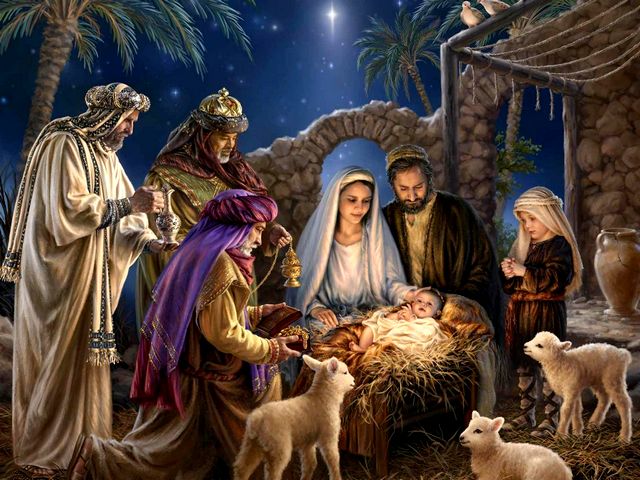
(The picture is by Dona Gelsinger. It was downloaded from bibleresearchtoday.com.)
In July, 2013, I found the grave of my great great grandfather, David Fisher. He is buried in the cemetery at St. John’s Evangelical Lutheran Church in the small village of Creagerstown, MD. Since that day I have desired to return to Creagerstown and worship with St. John’s. Organized in 1732, St. John’s is the oldest Lutheran church in continuous operation in western Maryland. The building in which my great great grandfather worshiped was built in 1834 and is still in use in the summer. The building used during the greater part of the year was built in 1908.
This past September 27, my wife, Marcia, and I worshiped with the congregation of St. John’s, in the 1908 building. As the hour came for worship to begin, as in ages past, the bell, not a digital recording, but the old church bell in the belfry rang declaring to the village that it was time to worship God. This was our first experience of Lutheran liturgy. A different tradition of worship, a new experience for both of us. What particularly moved my heart was the eucharist, the Lord’s Supper. As in our own tradition, St. John’s celebrates the Lord’s Supper every Sunday. What was different, new to us, touched my heart.
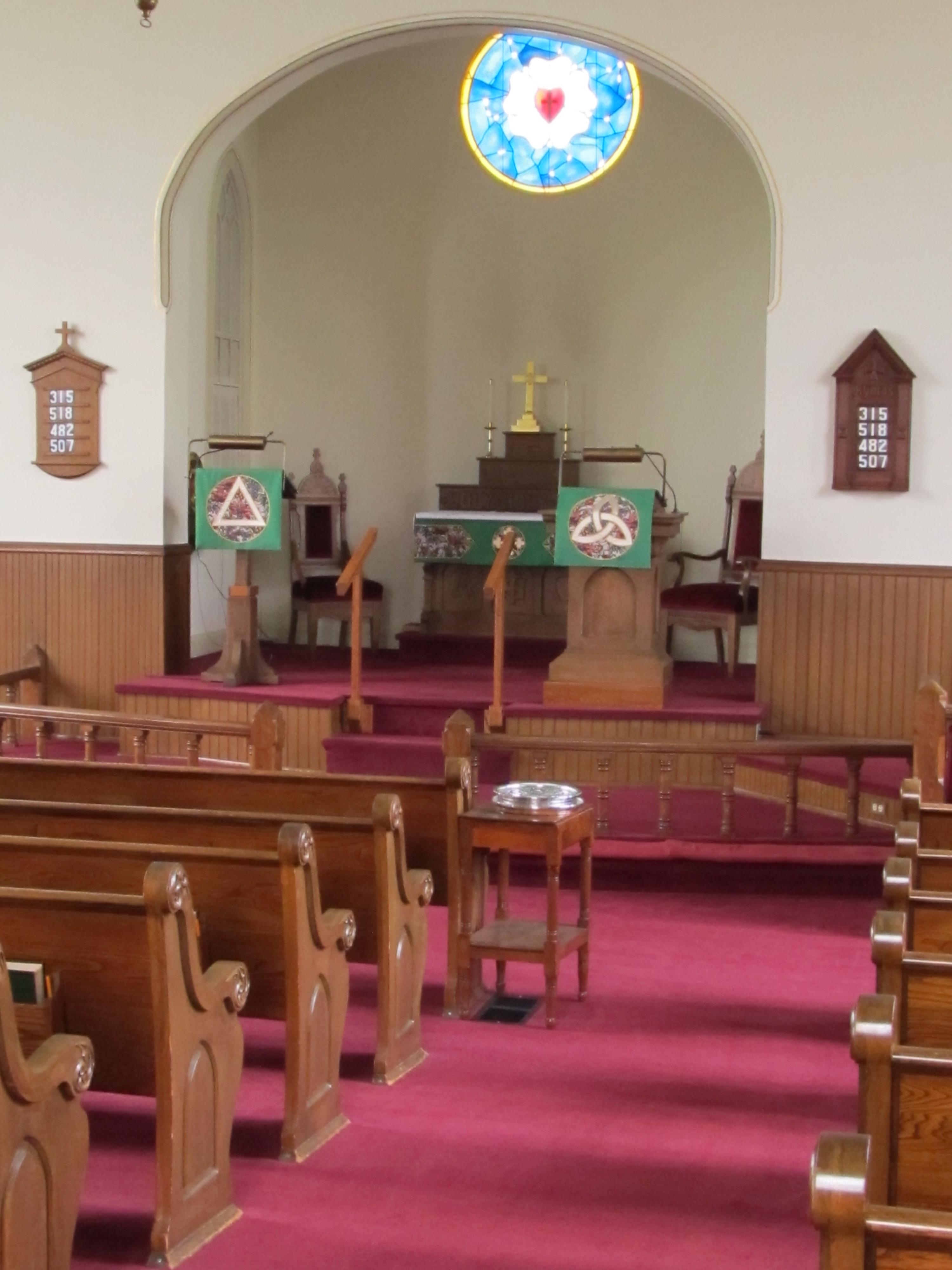
The minister read the words of Christ, which He spoke concerning the bread and the cup. In turn each row of worshipers walked to the railing before the pulpits, picking up a glass communion cup. You can see the tray holding the glasses, and see the railing, in the picture. At the railing those who were able kneeled down on both knees. Marcia and I kneeled down. The minister distributed to each worshiper a piece of the loaf. To each worshiper he said, “This is the body of the Lord given for you.” The bread was then eaten. Following the minister, the lay minister poured wine from a flagon into each worshiper’s cup. As he did so he said to each worshiper, “This is the blood of the Lord shed for you.” The worshiper then drank the wine. As each group of worshipers rose to return to their pews, the minister encouraged them, “Now go serve the Lord.” After all had partaken, the congregation stood. The minister said, “The body and blood of our Lord Jesus Christ strengthen you and keep you in his grace.” The congregation said, “Amen.”
The forms we choose with which to carry out the acts of worship are important. The question of form is whether the form we choose fits the meaning, and enhances the meaning, of the act of worship. I found the form chosen by St. John’s to partake of the of the Lord’s Supper very helpful and meaningful. I do not know what is taught in the catechism but I know what this celebration of the Lord’s Supper meant to me.
Approaching the front of the sanctuary and kneeling down at the railing brought me humbly and reverently before Christ on the cross. Kneeling before Him, the words spoken, the bread and the cup, I remembered the awful cost the Father’s love paid to save me. Humility and reverence, a trembling fear, before the cross, so meaningfully filled my heart in the simple act of kneeling as I ate the bread and drank the wine. Then rising to return to the pew, to return to the routine of life with the words encouraging me, “Now go serve the Lord.” What joy, for it was like walking to the tomb only to find it empty. The Lord is risen. Life is given. New life lived in service to Him who died, was buried, and rose, to give me salvation and life. The blessing of the Lord strengthening me and keeping me in His grace.
Humility, reverence, joy, are what I experienced in this different Lord’s Supper tradition. An experience I cherish and desire to experience again.
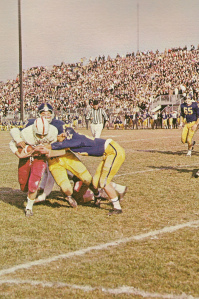
Every Thanksgiving I remember the crisp air, turkey, and football of my youth. There were no league championships or state playoffs. There was something bigger, the Turkey Day game with your arch rival. I remember the cool, sunny, Thanksgiving mornings at the stadium, with my friends. If you had a date you bought her a corsage with school colors. We cheered on our Liberty High School Hurricanes against the William Allen High School Canaries. One of my favorite pictures in my senior year book is of the Turkey Day game. There is Ron Mohap or Ron Kline struggling to break a tackle and cross the goal line. The picture captures everything about the event, the teams, the fans, the sunny, crisp air with the scents of autumn.
My memories are filled with things so often taken for granted–air, sun, autumn, friends, time to…
“So then, those who suffer according to God’s will should commit themselves to their faithful Creator and continue to do good” (1 Peter 4:19).
This fall my wife and I have especially found joy in the beauty and wonder of the vivid colors of the leaves. In death they speak to us the praises of the Creator. In death…
There are times when God does not deliver the faithful disciple from suffering, from hard times, from disappointments, even from death. Faithful prayers fervently rise to the throne of God. Scriptures promising deliverance are read, prayed, believed. Suffering does not end. Death comes.
In such times the apostle Peter encourages continuing commitment and obedience to God, our faithful Creator. More, Peter calls us to rejoice in the midst of suffering. “But rejoice that you participate in the sufferings of Christ, so that you may be overjoyed when his glory is revealed” (1 Peter 4:13). We see beauty in the death of the leaves. Peter wants us to see in our sufferings an intimacy with Christ, sharing with Him, having fellowship with Him. In this fellowship with Christ we are able to rejoice for we know there is coming a time when His glory will be revealed, a glory we will share in eternity. From the ashes we will rise and know a joy beyond description.
In such times of sharing with Christ in his sufferings our sufferings are redeemed. Satan brings suffering upon us to mock the name of Christ which we bear. He seeks to mock our faith in Christ as foolishness. In bearing the name of Christ, being faithful to that name, in the midst of suffering, our faith is not mocked. Rather, as we share in the sufferings of Christ the Spirit of glory and of God rests on us. Christ strengthens us to persevere in confidence and hope. Suffering redeemed. Suffering, a time to know intimacy with Christ. Suffering, a time to humbly and bravely bear the name of Christ. Suffering, a time to bear witness to the steadfast love and faithfulness of God in Christ Jesus.
“Dear friends, do not be surprised at the painful trial you are suffering, as though something strange were happening to you. But rejoice that you participate in the sufferings of Christ” (1 Peter 4:12-13).
“How great is the love the Father has lavished on us, that we should be called children of God! And that is what we are! We know that when he appears, we shall be like him, for we shall see him as he is. I write these things to you who believe in the name of the Son of God so that you may know that you have eternal life” (1 John 3:1, 2; 5:13).
I have sat by the bedside of a number of dying people who lived their lives by faith in Jesus Christ. Their belief in Christ, in his gift of salvation, in the hope of eternal life through the resurrected Christ and the grace of God, was strongly demonstrated in the way they lived their lives. They knew their salvation and hope were by grace, not by works. Yet as death was approaching, a number of these children of God asked, “Did I live a good enough life to enter into heaven?” Each time I have sought to encourage with God’s promise of grace. I have reminded them of their faith in Christ by which they stand in the grace of God and the hope of Christ.
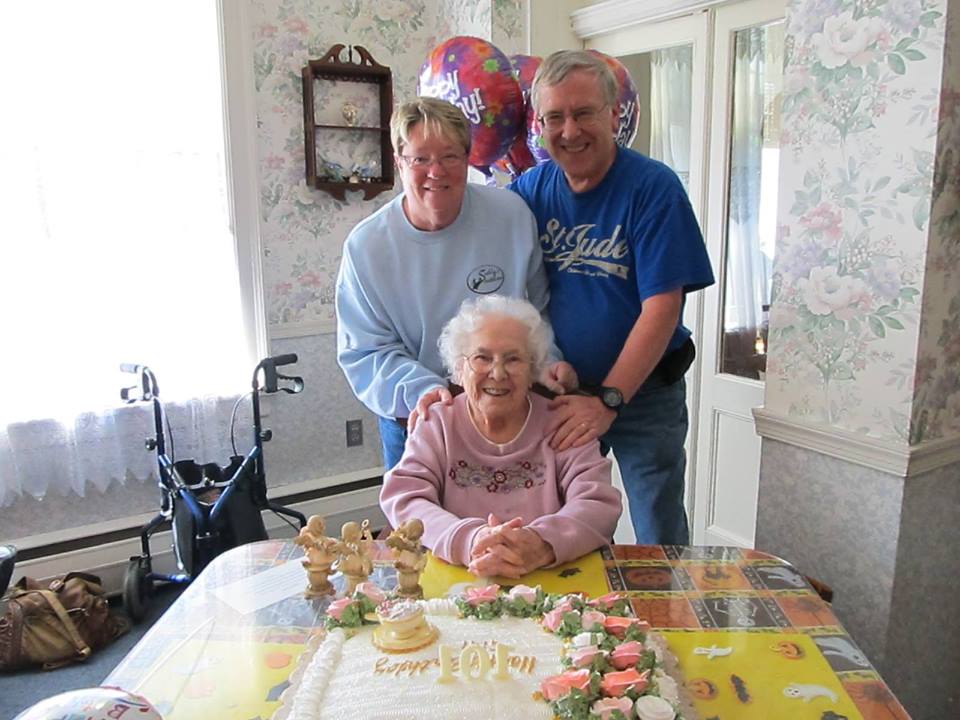
Now my godly mother realizes death is near. How near is in the Father’s hands. Yet her body and spirit are so very weak and tired. Her prayer is for Jesus to call her home. She and my father taught me about God’s grace and what it means to have faith in Christ. Now she asks, “Did I live a good enough life to enter into heaven? Am I worthy?” Her mind is beyond the point of being able to reason and remember. So even though she agrees with me when I encourage her, soon she questions again. I am saddened by the anxiety this causes her. My prayer is that the Spirit will break through the impact upon her mind by her age, her body’s weakness and tiredness. I pray for Him to be able to break through and give her peace in the hope she has in Christ.
As I seek to comfort my mother, as I have sought to comfort others in my years of ministry, I am caused to reflect on my own faith. The apostle John wrote his short letter so that I, and you, might know that I have eternal life. Know, not only the knowledge of a fact taught in Scripture, but the acceptance of the certainty of the reality of my salvation and the eternal life I have in Jesus Christ. I know that I have eternal life. Yet I ask myself, knowing my death is near, will I face death with the confidence of the knowledge of my salvation in Christ?
“Everyone who has this hope in him (Christ) purifies himself, just as he is pure” (1 John 3:3). The child of God seeks to purify himself, not in order to be saved, but because he is saved, he does have hope in Christ. Confident of God’s grace in Christ, of her hope of eternal life, my mother has lived her life seeking to purify herself, as Christ is pure. As a woman, as a wife, and as a mother, she has sought to imitate Christ in her heart, her words, and her actions. Lord, I pray that I have, and that I will, imitate my mother as she has imitated Christ. Lord, I pray that her heart and spirit will now be comforted by remembering how she has lived for you.






 Journey through the Shadowlands